-
Merit Badges
- Legend to identify Merit Badges
- 1910 British Merit Badges
- Square 1911 - 33
- Wide Crimped 1934 & 35
-
Narrow Tan Crimped 1936 - 42
- Tan Heavyweight Cloth with Silk Embroidery and Printed Back 1936 - 37
- Tan Heavyweight Cloth with Silk Embroidery and Plain Back 1937 - 38
- Tan Lightweight Cloth with Silk Embroidery and Plain Back 1938 - 39
- Tan Lightweight Cloth with Cotton Continuous Loop Embroidery and Plain Back 1939 - 42
- Tan Lightweight Cloth with Cotton Lockstitch Embroidery and Plain Back 1939 - 42
- Blue Background 1942 - 46
- Wartime 1942 - 46
- Khaki Narrow Crimped 1946 - 59
- Green Twill Gauze Back 1960 - 68
- Fully Embroidered Merrowed Edge 1960 - 72
- Unprinted Plastic Back 1972 - 01
- Printed Plastic Back 2002 - Current
-
Merit Badge Paper
- Merit Badge Applications
- Merit Badge Cards
-
Merit Badge Pamphlets
- Type 1 White Cover - Rectangle Drawing On Cover
- Type 2 White Cover 5-375" x 8" Title at Top
- Type 3A Tan Cover - 200 Fifth Avenue
- Type 3B Tan Cover - 2 line address New York City
- Type 3C Tan Cover - 2 line address New York N.Y.
- Type 3D Tan Cover - 1 line address New York N.Y.
- Type 4 Standing Scout Cover
- Type 5A War Cover
- Type 5B Red and White
- Type 6 Photo-Red Cover
- Type 7 Full Photo Cover or Bulls-eye Cover
- Type 8 Full Photo - Green Stripe Cover
- Type 9 Full Photo - Red Stripe Cover
- Type 10A Blue Stripe - Logo above bottom blue stripe - FDL centered
- Type 10B - Blue Stripe in bottom of photo area. FDL to left of text
- Special Covers
- Boy Craft Helps
- Merit Badge Counselor's Guides
-
Youth Position
- Junior Assistant Scoutmaster
- Senior Patrol Leader
- Assistant Senior Patrol Leader
- Patrol Leader
- Assistant Patrol Leader
- Troop Guide
- Scribe
- Quartermaster
- Instructor
- Chaplain Aide
- Den Chief
- Librarian
- Musician
- Webmaster
- Bugler
- Troop Historian
- Troop Representative
- Unit Representative
- Leadership Corps
- Honor Guard
- Leave No Trace Trainer
- Outdoor Ethics Guide
-
Patrol Medallions
- Patrol Medallions Introduction
- Legend to identify Patrol Medallions
- Patrol Shoulder Knot-Ribbons
- Felt Handmade Patrol Medallions
- Square Felt Patrol Medallions
- Round Broadcloth Patrol Medallions
- Red Twill Patrol Medallions
- Multi-Color Cloth Patrol Medallions
- Tan Cloth Patrol Medallions
- Patrol Medallion Back Patches
- Woodbadge Patrol Medallion
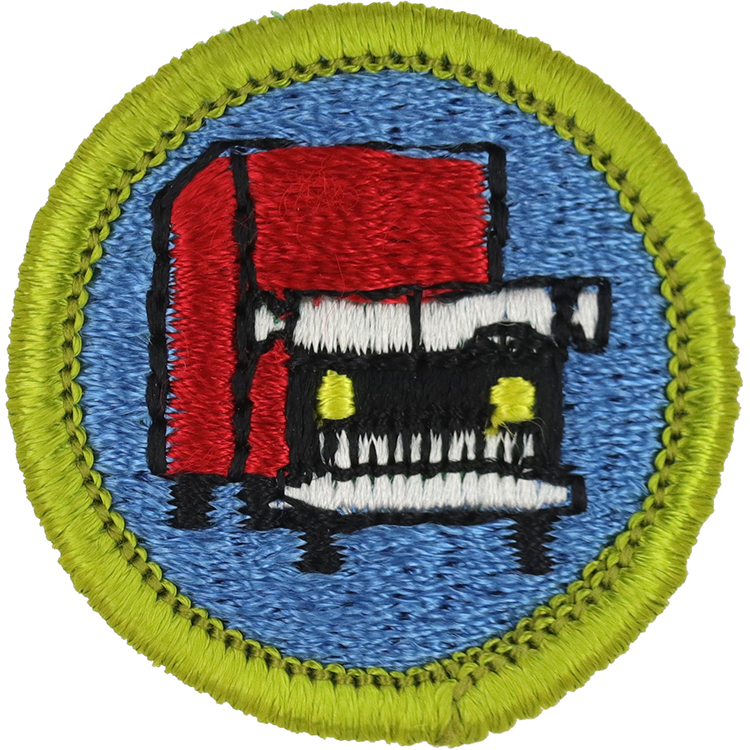
Fig. 1: TruTra-H3-Front
- Embroidery: Cotton thread, dull sheen
- Border: Dk green merrowed
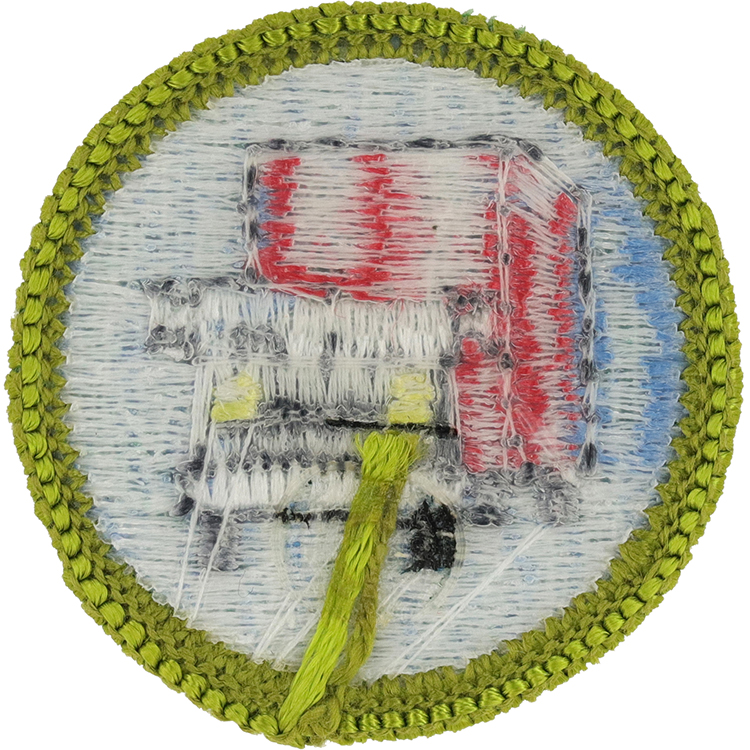
Fig. 2: TruTra-H3-Reverse
- Back: Molded plastic
Item Name: Truck Transportation 1976 - 1978
Item ID: TruTra-H3
Collector Rating: 1
Pamphlets Used to Earn this Badge
1. List the major truck lines serving your town.
2. Tell the importance of trucks in providing freight service to towns served by no other means. Name some towns in your area served only by trucks.
3. Describe how trucks fit in with other forms of transportation.
4. Describe the difference between the gasoline engine and the diesel engine that power trucks. List the advantages of each.
5. Visit a truck terminal and do the following:
(a) Check the use of communications facilities. What means are used? How does a dispatcher control over-the-road trucks? How does he control local trucks?
(b) Find out from the maintenance department the following: How many miles are engines run between overhauls? How do they get better tire life? How are breakdowns prevented? What maintenance work is done by the company? What work is done outside the company?
(c) Talk with a professional truck driver about safety. List five safe-driving rules he follows.
6. Outline the general organization of a truck company. Describe what each department does.
7. Do the following:
(a) List five jobs with trucking companies. Describe each.
(b) Talk with the safety director or driver supervisor about the requirements for becoming a professional truck driver.
8. Name five governmental agencies that regulate trucking. Tell what they regulate.
9. List five different kinds of trucks. Tell the service each gives.
10. Assume that you are going to ship 100 pounds from town to another by truck. Explain in writing how you would handle this shipment from your town to a place 500 miles away. Tell when the things are needed. List what truck lines are used. Tell how the shipment is insured for damage. Tell when it must be made if it is to arrive on time.
11. Define the following terms: APU, bill of lading, common carrier, containerization, ETA, logbook, fifth wheel, OS&D, LTL.