-
Merit Badges
- Legend to identify Merit Badges
- 1910 British Merit Badges
- Square 1911 - 33
- Wide Crimped 1934 & 35
-
Narrow Tan Crimped 1936 - 42
- Tan Heavyweight Cloth with Silk Embroidery and Printed Back 1936 - 37
- Tan Heavyweight Cloth with Silk Embroidery and Plain Back 1937 - 38
- Tan Lightweight Cloth with Silk Embroidery and Plain Back 1938 - 39
- Tan Lightweight Cloth with Cotton Continuous Loop Embroidery and Plain Back 1939 - 42
- Tan Lightweight Cloth with Cotton Lockstitch Embroidery and Plain Back 1939 - 42
- Blue Background 1942 - 46
- Wartime 1942 - 46
- Khaki Narrow Crimped 1946 - 59
- Green Twill Gauze Back 1960 - 68
- Fully Embroidered Merrowed Edge 1960 - 72
- Unprinted Plastic Back 1972 - 01
- Printed Plastic Back 2002 - Current
-
Merit Badge Paper
- Merit Badge Applications
- Merit Badge Cards
-
Merit Badge Pamphlets
- Type 1 White Cover - Rectangle Drawing On Cover
- Type 2 White Cover 5-375" x 8" Title at Top
- Type 3A Tan Cover - 200 Fifth Avenue
- Type 3B Tan Cover - 2 line address New York City
- Type 3C Tan Cover - 2 line address New York N.Y.
- Type 3D Tan Cover - 1 line address New York N.Y.
- Type 4 Standing Scout Cover
- Type 5A War Cover
- Type 5B Red and White
- Type 6 Photo-Red Cover
- Type 7 Full Photo Cover or Bulls-eye Cover
- Type 8 Full Photo - Green Stripe Cover
- Type 9 Full Photo - Red Stripe Cover
- Type 10A Blue Stripe - Logo above bottom blue stripe - FDL centered
- Type 10B - Blue Stripe in bottom of photo area. FDL to left of text
- Special Covers
- Boy Craft Helps
- Merit Badge Counselor's Guides
-
Youth Position
- Junior Assistant Scoutmaster
- Senior Patrol Leader
- Assistant Senior Patrol Leader
- Patrol Leader
- Assistant Patrol Leader
- Troop Guide
- Scribe
- Quartermaster
- Instructor
- Chaplain Aide
- Den Chief
- Librarian
- Musician
- Webmaster
- Bugler
- Troop Historian
- Troop Representative
- Unit Representative
- Leadership Corps
- Honor Guard
- Leave No Trace Trainer
- Outdoor Ethics Guide
-
Patrol Medallions
- Patrol Medallions Introduction
- Legend to identify Patrol Medallions
- Patrol Shoulder Knot-Ribbons
- Felt Handmade Patrol Medallions
- Square Felt Patrol Medallions
- Round Broadcloth Patrol Medallions
- Red Twill Patrol Medallions
- Multi-Color Cloth Patrol Medallions
- Tan Cloth Patrol Medallions
- Patrol Medallion Back Patches
- Woodbadge Patrol Medallion
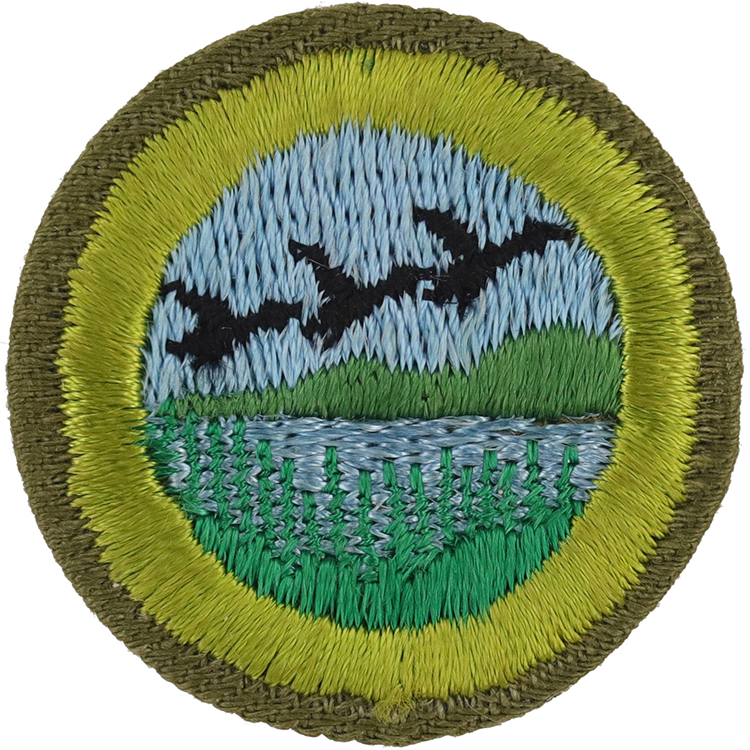
Fig. 1: WilMan-E2-Front
- Cloth: Khaki right twill
- Embroidery: Cotton lock stitch
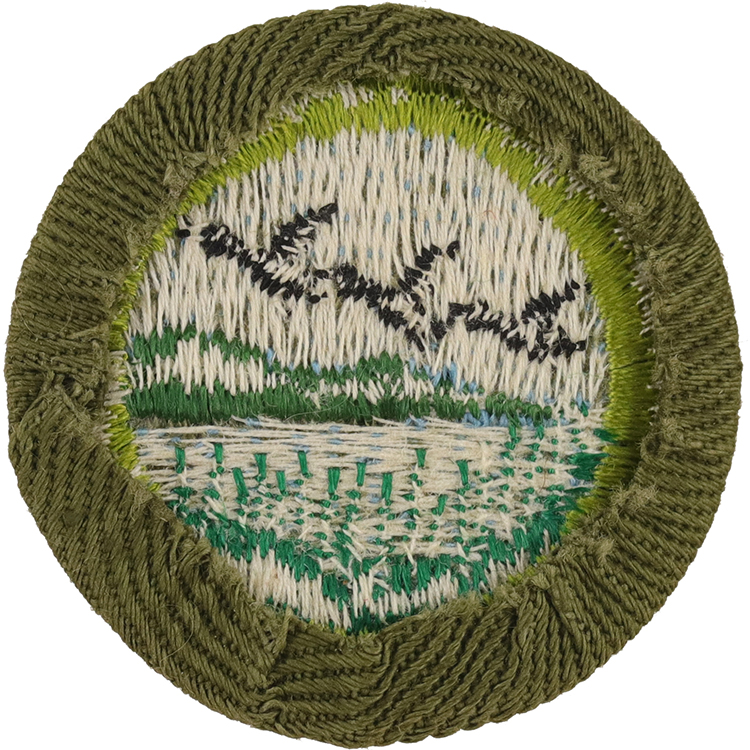
Fig. 2: WilMan-E2-Reverse
- Back: Plain NO imprint with starch
Item Name: Wildlife Management 1952 - 1960
Item ID: WilMan-E2
Collector Rating: 1
Pamphlets Used to Earn this Badge


Requirements January 1952 until January 1957
1. Do one:
a. On a rough sketch of a five-acre area--
(1) Show and identify the chief types of plant cover;
(2) Show the location (and identify) nests, dens, runways, droppings, feeding and other animal signs.
b. On a five-acre area--(1) Identify three of the chief tree, three of shrub, or three ground cover species used by animals for food, shelter or cover. (2) Identify by signs or sign, 10 of the animal species found in the area.
2. Describe the value of three wild animals each as sources of food, clothing and recreation; and the role of three animals each in insect, weed and rodent control.
3. (a) Describe the damage to wildlife resulting from wildfire, overgrazing, unwise forest practices, soil erosion, unwise drainage, "slick and clean" farming, and water pollution. (b) Explain the relationship between wildlife and the natural habitat and how man controls the natural environment.
4. Explain who makes laws setting definite seasons and bag limits on hunting, fishing and trapping in your state, and the reason for the laws.
5. Do one:
a. Make a wildlife count on each of two contrasting approximate five-acre plots. Grazed versus ungrazed woodlots; or strip cropped versus solid planting; or burned over versus not burned over area; or other contrasting areas.
b. Visit a state or federal or private game refuge or game management area with a wildlife technician, and write at least 500 words on what is being done to make the area better for wildlife.
c. Visit a game farm or fish hatchery with a wildlife technician and write a report of at least 500 words on the pros and cons of game stocking against habitat improvements as means of increasing wildlife populations.
d. Attend a recognized camp for at least a week where conservation is a major part of the program and describe how you will use the information you learned.
e. Go out for at least two days with a commercial fisherman and describe his catch and methods used.
f. Select one wildlife species common to your neighborhood and find out what management practices are used, or the practices that may be necessary to maintain the species.
6. Do one:
a. Help build, stock or fertilize a farm pond.
b. Plant stream or ditch banks to control erosion.
c. Build a fence or plant a "living fence" to exclude stock from a woodlot, stream or pond banks, or other easily damaged wildlife habitat.
d. Set out 200 food plants for birds and mammals.
e. Build three check dams, deflectors or cover devices in a stream or lake to provide shelter for fish and to help reduce erosion.
f. Study the fish species in a pond or lake, and if necessary carry out such practices as may be necessary to benefit the fish.
g. Build and set out in suitable places ten nesting boxes or "den pipes."
h. Plant a windbreak or hedge or other suitable winter cover for wildlife.
i. Help plant a gully, road cut, fill or eroding area, to reduce erosion, build up soil fertility and at the same time provide shelter for wildlife.
Requirements January 1957 until June 1972
1. Do one:
(a) On a rough sketch of a five-acre area--
(1) Show and identify the chief types of plant cover;
(2) Show the location (and identify) nests, dens, runways, droppings, feeding, and other animal signs.
(b) On a five-acre area--(1) Identify three of the chief tree, three of shrub, or three ground cover species used by animals for food, shelter, or cover. (2) Identify by signs, or sight, ten of the animal species found in the area.
2. Describe the value of three wild animals, each as sources of food, clothing, and recreation; and the role of three animals each in insect, weed, and rodent control.
3. (a) Describe the damage to wildlife resulting from wildfire, overgrazing, unwise forest practices, soil erosion, unwise drainage, "slick and clean" farming, and water pollution. (b) Explain the relationship between wildlife and the natural habitat and how man controls the natural environment.
4. Explain who makes laws setting definite seasons and bag limits on hunting, fishing, and trapping in your state and the reason for the laws.
5. Do one:
(a) Make a wildlife count on each of two contrasting approximate five-acre plots. Grazed versus ungrazed wood lots; or strip cropped versus solid planting; or burned-over versus not burned-over area; or other contrasting areas.
(b) Visit a state or federal or private game refuge or game management area with a wildlife technician and write at least 500 words on what is being done to make the area better for wildlife.
(c) Visit a game farm or fish hatchery with a wildlife technician and write a report of at least 500 words on the pros and cons of game stocking against habitat improvements as means of increasing wildlife populations.
(d) Attend a recognized camp for at least a week where conservation is a major part of the program and describe how you will use the information you learned.
(e) Go out for at least two days with a commercial fisherman and describe his catch and methods used.
(f) Select one wildlife species common to your neighborhood and find out what management practices are used, or the practices that may be necessary to maintain the species.
6. Do one:
(a) Help build, stock, or fertilize a farm pond.
(b) Plant stream or ditch banks to control erosion.
(c) Build a fence or plant a "living fence" to exclude stock from a wood lot, stream, or pond banks, or other easily damaged wildlife habitat.
(d) Set out 200 food plants for birds and mammals.
(e) Build three check dams, deflectors, or cover devices in a stream or lake to provide shelter for fish and to help reduce erosion.
(f) Study the fish species in a pond or lake and, if necessary, carry out such practices as may be necessary to benefit the fish.
(g) Build and set out in suitable places ten nesting boxes or "den pipes."
(h) Plant a windbreak or hedge or other suitable winter cover for wildlife.
(i) Help plant a gully, road cut, fill or eroding area, to reduce erosion, build up soil fertility, and at the same time provide shelter for wildlife.
-------
* As a 4-H'er, complete a club project in this subject. Or as an FFA member, meet these or equivalent requirements through the FFA supervised farming program.