-
Merit Badges
- Legend to identify Merit Badges
- 1910 British Merit Badges
- Square 1911 - 33
- Wide Crimped 1934 & 35
-
Narrow Tan Crimped 1936 - 42
- Tan Heavyweight Cloth with Silk Embroidery and Printed Back 1936 - 37
- Tan Heavyweight Cloth with Silk Embroidery and Plain Back 1937 - 38
- Tan Lightweight Cloth with Silk Embroidery and Plain Back 1938 - 39
- Tan Lightweight Cloth with Cotton Continuous Loop Embroidery and Plain Back 1939 - 42
- Tan Lightweight Cloth with Cotton Lockstitch Embroidery and Plain Back 1939 - 42
- Blue Background 1942 - 46
- Wartime 1942 - 46
- Khaki Narrow Crimped 1946 - 59
- Green Twill Gauze Back 1960 - 68
- Fully Embroidered Merrowed Edge 1960 - 72
- Unprinted Plastic Back 1972 - 01
- Printed Plastic Back 2002 - Current
-
Merit Badge Paper
- Merit Badge Applications
- Merit Badge Cards
-
Merit Badge Pamphlets
- Type 1 White Cover - Rectangle Drawing On Cover
- Type 2 White Cover 5-375" x 8" Title at Top
- Type 3A Tan Cover - 200 Fifth Avenue
- Type 3B Tan Cover - 2 line address New York City
- Type 3C Tan Cover - 2 line address New York N.Y.
- Type 3D Tan Cover - 1 line address New York N.Y.
- Type 4 Standing Scout Cover
- Type 5A War Cover
- Type 5B Red and White
- Type 6 Photo-Red Cover
- Type 7 Full Photo Cover or Bulls-eye Cover
- Type 8 Full Photo - Green Stripe Cover
- Type 9 Full Photo - Red Stripe Cover
- Type 10A Blue Stripe - Logo above bottom blue stripe - FDL centered
- Type 10B - Blue Stripe in bottom of photo area. FDL to left of text
- Special Covers
- Boy Craft Helps
- Merit Badge Counselor's Guides
-
Youth Position
- Junior Assistant Scoutmaster
- Senior Patrol Leader
- Assistant Senior Patrol Leader
- Patrol Leader
- Assistant Patrol Leader
- Troop Guide
- Scribe
- Quartermaster
- Instructor
- Chaplain Aide
- Den Chief
- Librarian
- Musician
- Webmaster
- Bugler
- Troop Historian
- Troop Representative
- Unit Representative
- Leadership Corps
- Honor Guard
- Leave No Trace Trainer
- Outdoor Ethics Guide
-
Patrol Medallions
- Patrol Medallions Introduction
- Legend to identify Patrol Medallions
- Patrol Shoulder Knot-Ribbons
- Felt Handmade Patrol Medallions
- Square Felt Patrol Medallions
- Round Broadcloth Patrol Medallions
- Red Twill Patrol Medallions
- Multi-Color Cloth Patrol Medallions
- Tan Cloth Patrol Medallions
- Patrol Medallion Back Patches
- Woodbadge Patrol Medallion
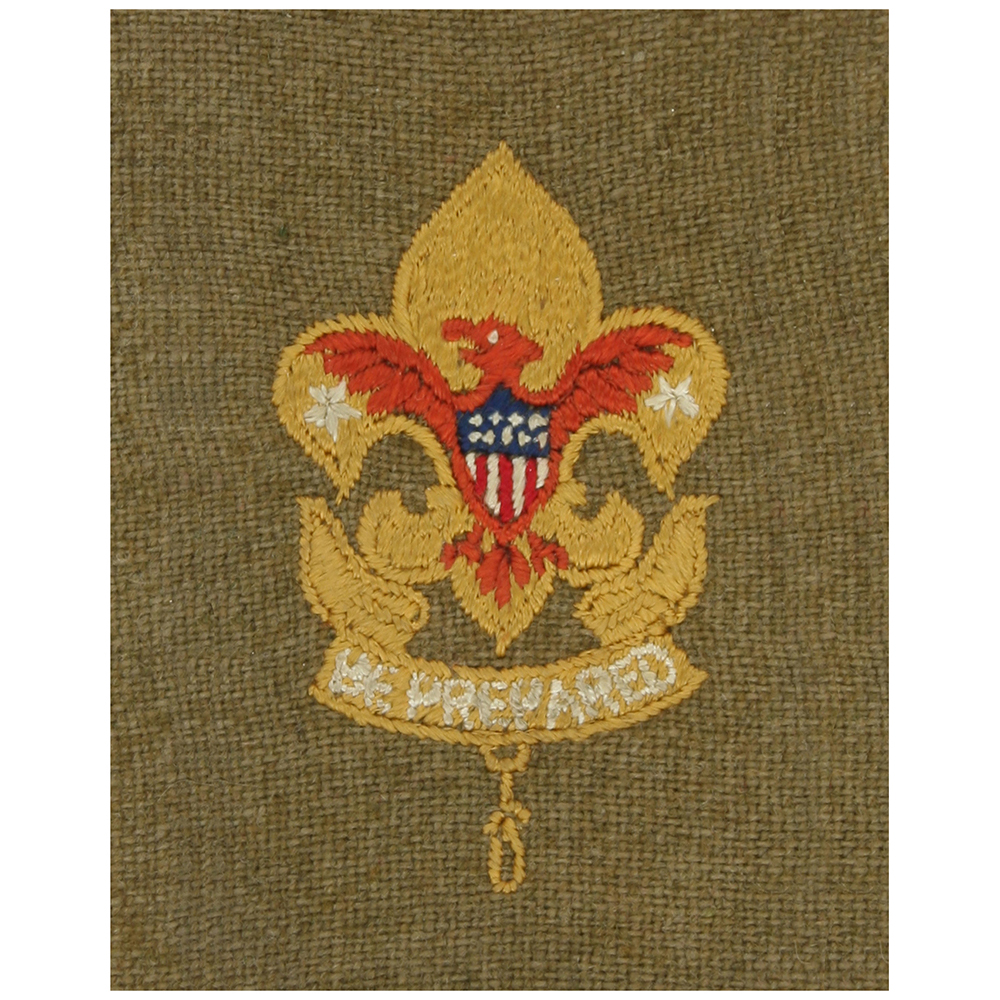
Fig. 1: FCB-1-1-01W-Front
- Size: 43mm FDL
- Cloth: Wool
- Embroidery: Continuous silk
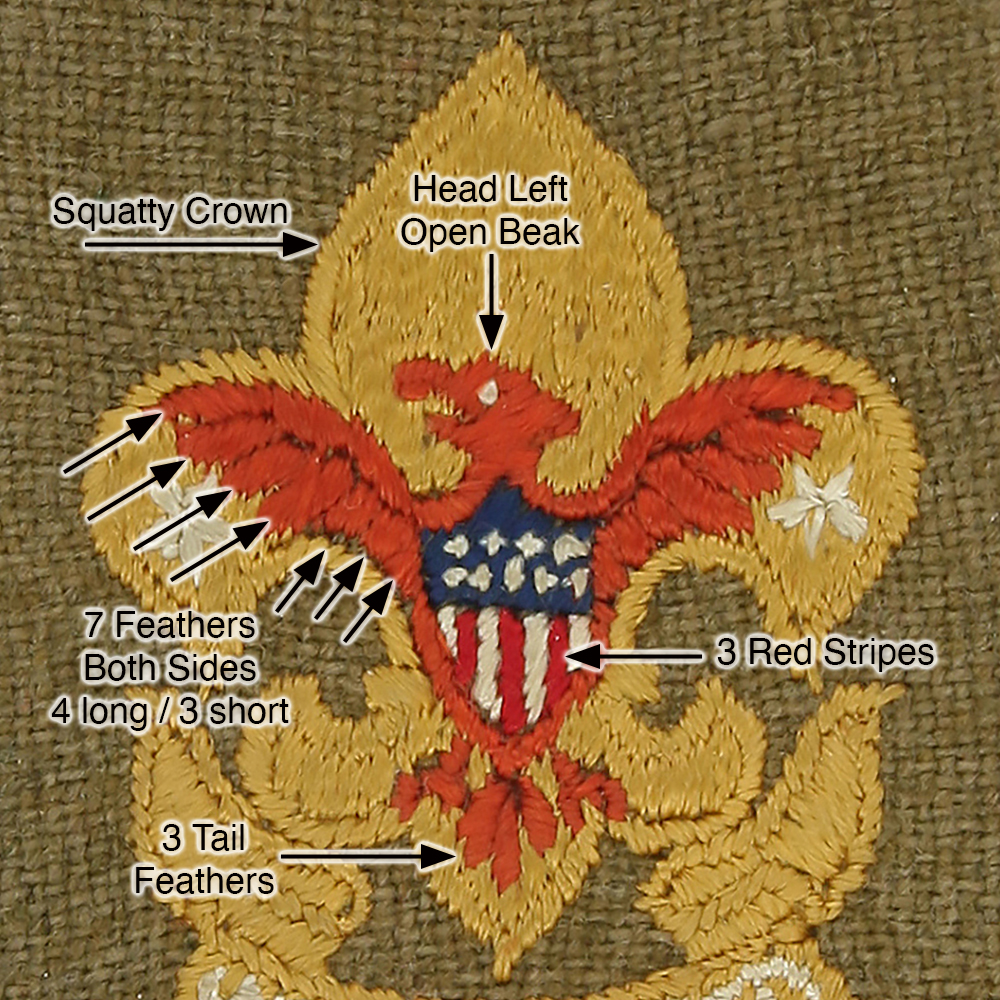
Fig. 2: FCB-1-1-01W-Magnified-Eagle
- Crown: Squatty
- Head: Faces left with open beak
- Wing Feathers: 7, 4 long / 3 short
- Shield: 3 red stripes
- Tail Feathers: 3
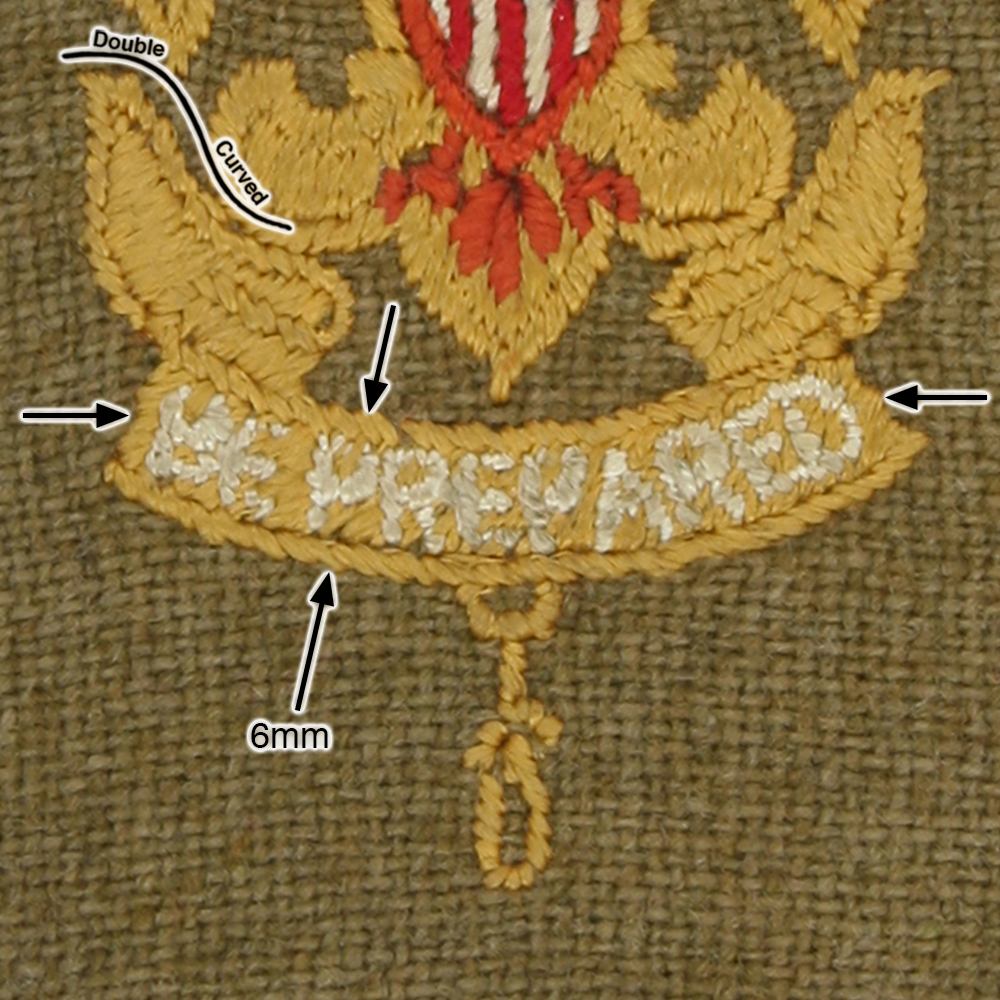
Fig. 3: FCB-1-1-01W-Magnified-Scroll
- Scroll Tops: High smile, double curved
- Smile: Open ended, 6mm height
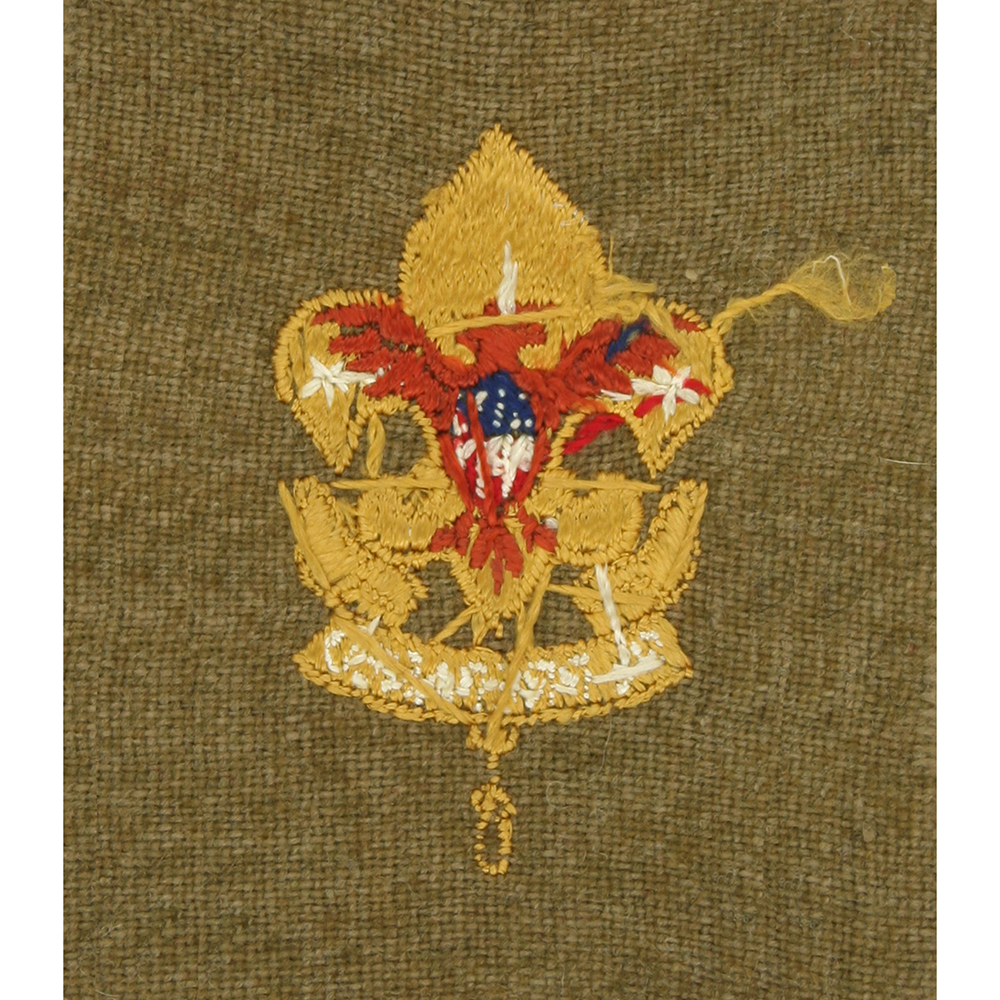
Fig. 4: FCB-1-1-01W-Reverse
- Back: Brown imprint
Item Name: First Class Badge 1914
Item ID: FCB-1-1-01W
Collector Rating: 10
Requirements October 1913 until October 1914
To become a first-class scout, the second-class scout must pass the following test:
1. Swim fifty yards.
2. Earn and deposit at least two dollars in a public bank.
3. Send and receive a message by semaphore, or International Morris alphabet, 16 letters per minute.
4. Make a round-trip alone (or with another scout) to a point at least 7 miles away, going on foot or rowing boat, and write a satisfactory account of the trip and things observed.
5. Advanced first aid: Know the methods for panic prevention; what to do in case of fire and ice, electric and gas accidents; how to help in case of runaway horse, mad dog, or snake bite; treatment for dislocations, unconsciousness, poisoning, fainting, apoplexy, sunstroke, heat exhaustion, and freezing; know treatment for sunburn, ivy poisoning, bites and stings, nosebleed, ear ache, toothache, inflammation or grit in the eye, cramp or stomach ache and chills; demonstrate artificial respiration.
6. Prepare and cook satisfactorily, in the open, without regular kitchen utensils, two of the following articles as may be directed: Eggs, bacon, hunters stew, fish, fowl, game, pancakes, hoe-cake, biscuit, hardtack or a "twist" baked on a stick; explained to another boy the methods follow.
7. Read a map correctly, and draw, from field notes made on the spot, and intelligible rough sketch map, indicating by their proper marks important buildings, roads, trolley lines, main landmarks, principal elevations, etc. Point out a compass direction without the help of a compass.
8. Use properly an axe for felling or trimming light timber; or produce an article of carpentry or cabinet-making or metal work made by himself. Explain the method followed.
9. Judge distance, size, number, height, and weight within 25%.
10. Describe fully from observation ten species of trees or plants, including poison ivy, by their bark, leaves, flowers, fruit, or scent; or six species of wild birds by their plumage, notes, tracks, or habits; or six species of native wild animals by their form, color, call, tracks, or habits; find the North Star, and name and describe at least three constellations of stars.
11. Furnish satisfactory evidence that he has put into practice in his daily life the principles of the Scout oath and Law.
12. Enlist a boy trained by himself in the requirements of a tenderfoot.
Requirements October 1914 until December 1916
To become a first-class scout, the second-class scout must have served as a second-class scout for at least two months and pass the following test:
1. Swim fifty yards.
2. Earn and deposit at least two dollars in a public bank.
3. Send and receive a message by Semaphore, or International Morris alphabet, including conventional signs, sixteen letters per minute.
4. Make a round-trip alone (or with another scout) to a point at least seven miles away (fourteen miles in all), going on foot or rowing boat, and write a satisfactory account of the trip and things observed.
5. Advanced first aid: Know the methods for panic prevention; what to do in case of fire, ice, electric and gas accidents; how to help in case of runaway horse, mad dog, or snake bite; treatment for dislocations, unconsciousness, poisoning, fainting, apoplexy, sunstroke, heat exhaustion, and freezing; know treatment for sunburn, ivy poisoning, bites and stings, nosebleed, ear ache, toothache, inflammation or grit in the eye, cramp or stomach ache and chills; demonstrate artificial respiration.
6. Prepare and cook satisfactorily, in the open, without regular kitchen utensils, two of the following articles as may be directed: Eggs, bacon, hunters stew, fish, fowl, game, pancakes, hoe-cake, biscuit, hardtack or a "twist" baked on a stick; explained to another boy the methods follow.
7. Read a map correctly, and draw, from field notes made on the spot, and intelligible rough sketch map, indicating by their proper marks important buildings, roads, trolley lines, main landmarks, principal elevations, etc. Point out a compass direction without the help of a compass.
8. Use properly an ax for felling or trimming light timber; or produce an article of carpentry, cabinet-making or metal work made by himself. Explain the method followed.
9. Judge distance, size, number, height, and weight within 25%.
10. Describe fully from observation ten species of trees or plants, including poison ivy, by their bark, leaves, flowers, fruit, or scent; or six species of wild birds by their plumage, notes, tracks, or habits; or six species of native wild animals by their form, color, call, tracks, or habits; find the North Star, and name and describe at least three constellations of stars.
11. Furnish satisfactory evidence that he has put into practice in his daily life the principles of the Scout oath and Law.
12. Enlist a boy trained by himself in the requirements of a tenderfoot.