-
Merit Badges
- Legend to identify Merit Badges
- 1910 British Merit Badges
- Square 1911 - 33
- Wide Crimped 1934 & 35
-
Narrow Tan Crimped 1936 - 42
- Tan Heavyweight Cloth with Silk Embroidery and Printed Back 1936 - 37
- Tan Heavyweight Cloth with Silk Embroidery and Plain Back 1937 - 38
- Tan Lightweight Cloth with Silk Embroidery and Plain Back 1938 - 39
- Tan Lightweight Cloth with Cotton Continuous Loop Embroidery and Plain Back 1939 - 42
- Tan Lightweight Cloth with Cotton Lockstitch Embroidery and Plain Back 1939 - 42
- Blue Background 1942 - 46
- Wartime 1942 - 46
- Khaki Narrow Crimped 1946 - 59
- Green Twill Gauze Back 1960 - 68
- Fully Embroidered Merrowed Edge 1960 - 72
- Unprinted Plastic Back 1972 - 01
- Printed Plastic Back 2002 - Current
-
Merit Badge Paper
- Merit Badge Applications
- Merit Badge Cards
-
Merit Badge Pamphlets
- Type 1 White Cover - Rectangle Drawing On Cover
- Type 2 White Cover 5-375" x 8" Title at Top
- Type 3A Tan Cover - 200 Fifth Avenue
- Type 3B Tan Cover - 2 line address New York City
- Type 3C Tan Cover - 2 line address New York N.Y.
- Type 3D Tan Cover - 1 line address New York N.Y.
- Type 4 Standing Scout Cover
- Type 5A War Cover
- Type 5B Red and White
- Type 6 Photo-Red Cover
- Type 7 Full Photo Cover or Bulls-eye Cover
- Type 8 Full Photo - Green Stripe Cover
- Type 9 Full Photo - Red Stripe Cover
- Type 10A Blue Stripe - Logo above bottom blue stripe - FDL centered
- Type 10B - Blue Stripe in bottom of photo area. FDL to left of text
- Special Covers
- Boy Craft Helps
- Merit Badge Counselor's Guides
-
Youth Position
- Junior Assistant Scoutmaster
- Senior Patrol Leader
- Assistant Senior Patrol Leader
- Patrol Leader
- Assistant Patrol Leader
- Troop Guide
- Scribe
- Quartermaster
- Instructor
- Chaplain Aide
- Den Chief
- Librarian
- Musician
- Webmaster
- Bugler
- Troop Historian
- Troop Representative
- Unit Representative
- Leadership Corps
- Honor Guard
- Leave No Trace Trainer
- Outdoor Ethics Guide
-
Patrol Medallions
- Patrol Medallions Introduction
- Legend to identify Patrol Medallions
- Patrol Shoulder Knot-Ribbons
- Felt Handmade Patrol Medallions
- Square Felt Patrol Medallions
- Round Broadcloth Patrol Medallions
- Red Twill Patrol Medallions
- Multi-Color Cloth Patrol Medallions
- Tan Cloth Patrol Medallions
- Patrol Medallion Back Patches
- Woodbadge Patrol Medallion
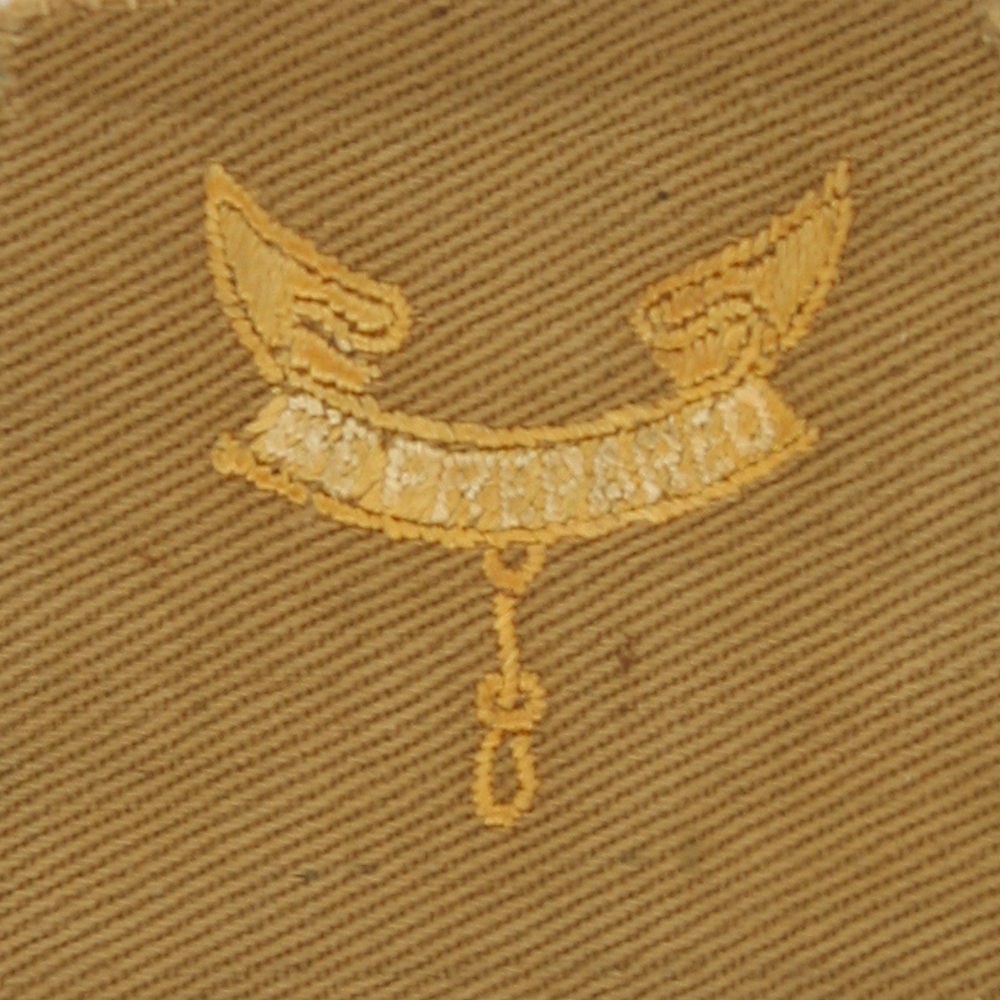
Fig. 1: SCB-1-1-05-Front
- Size: 36-15-5mm
- Cloth: Heavyweight tan right twill
- Embroidery: Continuous silk
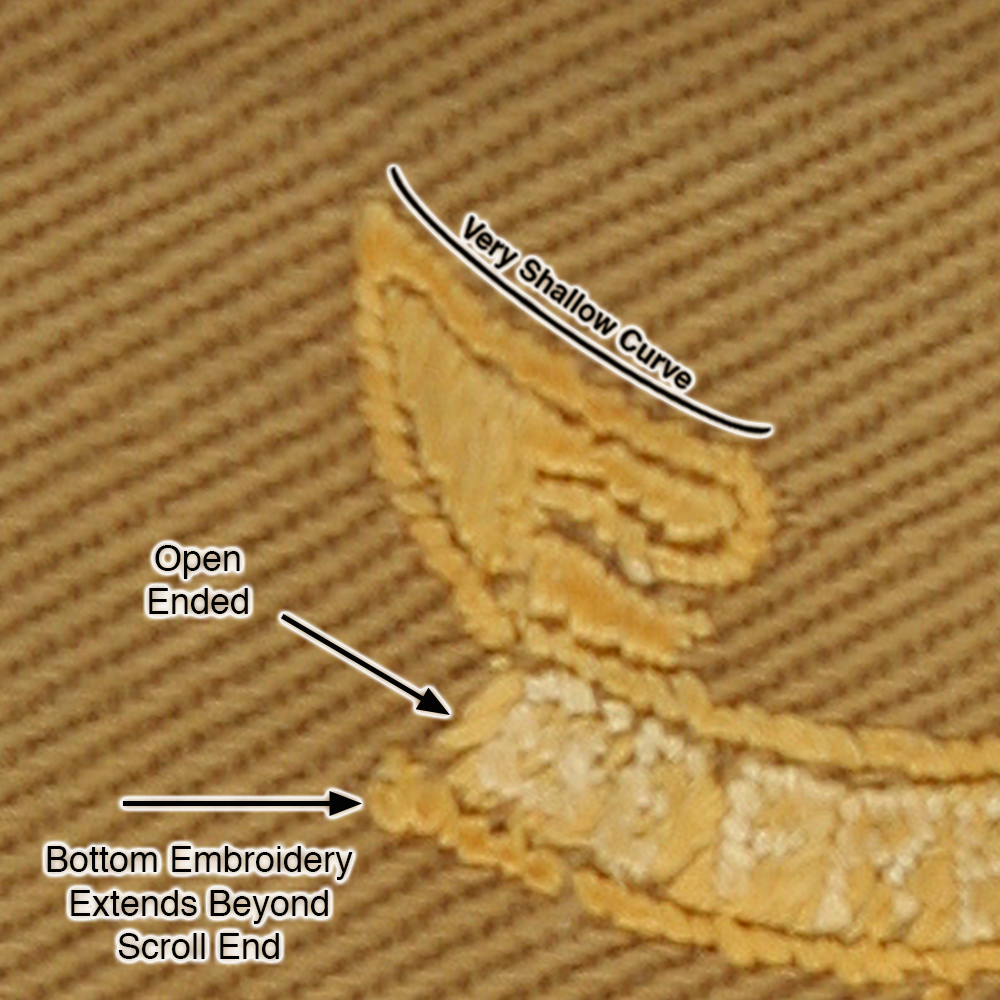
Fig. 2: SCB-1-1-05-Magnified-Scroll-Left
- Scroll Left: Very shallow concave curved scroll top, ribbon embroidery angled upward left-to-right, open ended smile, bottom embroidery extends beyond scroll end
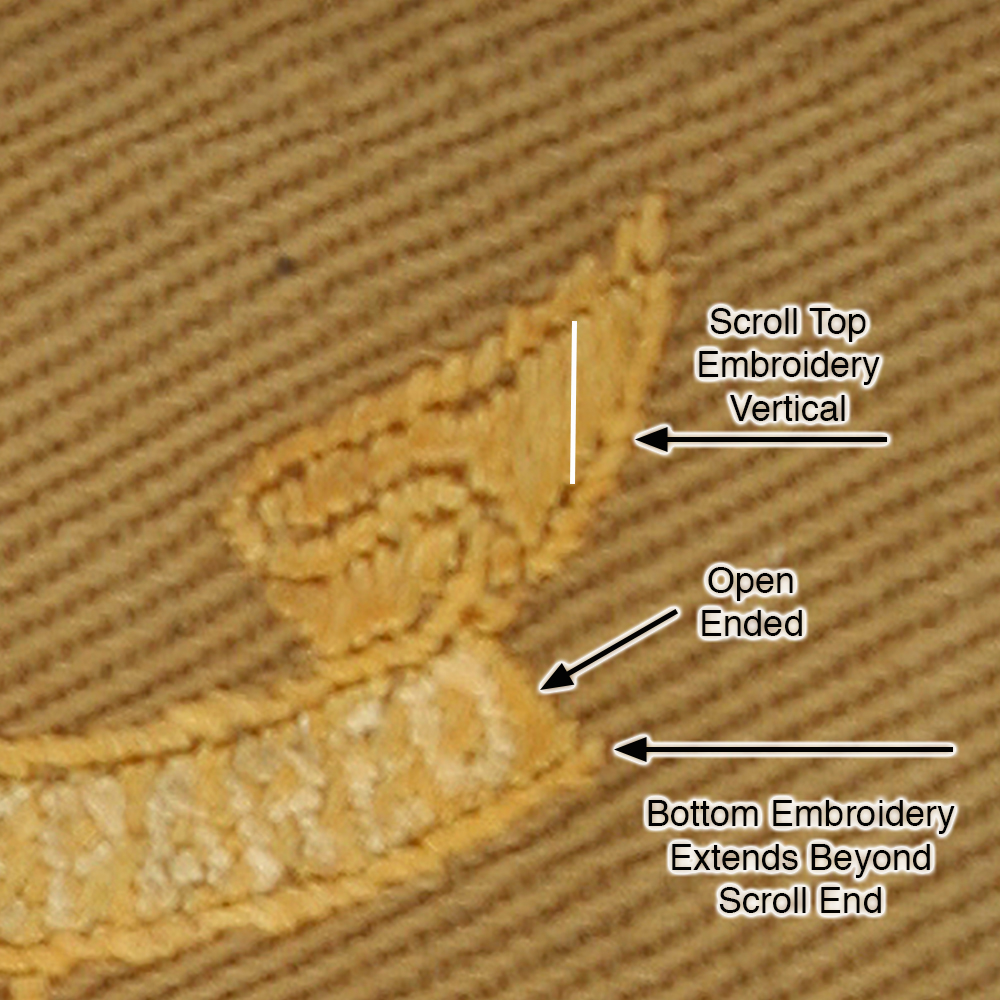
Fig. 3: SCB-1-1-05-Magnified-Scroll-Right
- Scroll Right: Very shallow concave curved scroll top, scroll top embroidery vertical, open ended smile, bottom embroidery extends beyond scroll end
Fig. 4: "Media Not Available"
- Knot: 15mm knot
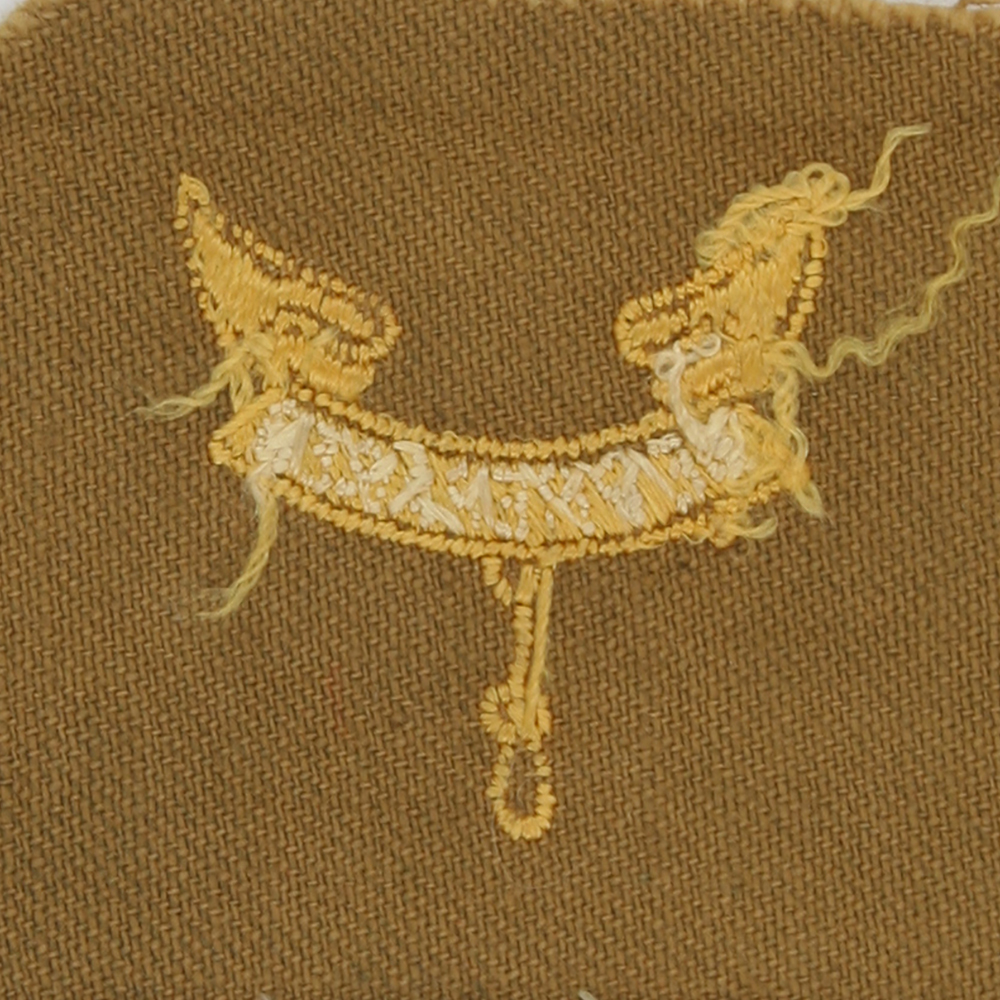
Fig. 5: SCB-1-1-05-Reverse
- Back: Brown imprint back
Item Name: Second Class Badge 1915 - 1918
Item ID: SCB-1-1-05
Collector Rating: 9
Requirements February 1914 until December 1916
To become a second-class scout, a tenderfoot must pass, to the satisfaction of the recognized local scout authorities, the following tests:
1. At least one month’s service as a Tenderfoot.
2. Elementary first aid and bandaging; know the general directions for first aid for injuries; know treatment for fainting, shock, fractures, bruises, sprains, injuries in which the skin is broken, burns and scalds; demonstrate how to carry injured, and the use of the triangular and roller bandages and tourniquet.
3. Elementary signaling: Know the semaphore, or the International Morse alphabet.
4. Track half a mile in twenty-five minutes; or, if in town, describe satisfactorily the contents of one store window out of four, observed for one minute each.
5. Go a mile in twelve minutes at scout pace – about fifty steps running and fifty walking, alternately.
6. Use properly knife and hatchet.
7. Prove ability to build a fire in the open, using not more than two matches.
8. Cook a quarter of a pound of meat and two potatoes in the open without the ordinary cooking.
9. Earn and deposit at least one dollar in a public bank.
10. Know the sixteen principle points of the compass.
Requirements December 1916 until December 1917
A tenderfoot scout may, upon passing the following tests to the satisfaction of the proper local scout authorities, be enrolled as a second-class scout. He is the entitled to wear the second class badge of the Boy Scouts of America.
1. At least one month’s service as a Tenderfoot.
2. Elementary first aid and bandaging; know the general directions for first aid for injuries; know treatment for fainting, shock, fractures, bruises, sprains, injuries in which the skin is broken, burns and scalds; demonstrate how to carry injured, and the use of the triangular and roller bandages and tourniquet.
3. Elementary signaling: Know the alphabet of the Semaphore or the General Service (International Morse) Code.
4. Track half a mile in twenty-five minutes; or, if in town, describe satisfactorily the contents of one store window out of four, observed for one minute each.
5. Go a mile in twelve minutes at scout pace – about fifty steps running and fifty walking, alternately.
6. Use properly knife and hatchet.
7. Prove ability to build a fire in the open, using not more than two matches.
8. Cook a quarter of a pound of meat and two potatoes in the open without the ordinary cooking.
9. Earn and deposit at least one dollar in a public bank.
10. Know the sixteen principle points of the compass.
Requirements December 1917 until June 1921
A tenderfoot scout may, upon passing the following tests to the satisfaction of the proper local scout authorities, be enrolled as a second-class scout. He is the entitled to wear the second class badge of the Boy Scouts of America.
1. At least one month’s service as a Tenderfoot.
2. Elementary first aid and bandaging; know the general directions for first aid for injuries; know treatment for fainting, shock, fractures, bruises, sprains, injuries in which the skin is broken, burns and scalds; demonstrate how to carry injured, and the use of the triangular and roller bandages and tourniquet.
3. Elementary signaling: Know the alphabet of the Semaphore or the General Service (International Morse) Code.
4. Track half a mile in twenty-five minutes; or, if in town, describe satisfactorily the contents of one store window out of four, observed for one minute each.
5. Go a mile in twelve minutes at scout pace – about fifty steps running and fifty walking, alternately
6. Use properly knife and hatchet.
7. Prove ability to lay and light a fire in the open, using not more than two matches.
8. Cook a quarter of a pound of meat and two potatoes in the open without the ordinary cooking.
9. Earn and deposit at least one dollar in a public bank. (Liberty Loan subscriptions and war savings certificates are acceptable)
10. Know the sixteen principle points of the compass.