-
Merit Badges
- Legend to identify Merit Badges
- 1910 British Merit Badges
- Square 1911 - 33
- Wide Crimped 1934 & 35
-
Narrow Tan Crimped 1936 - 42
- Tan Heavyweight Cloth with Silk Embroidery and Printed Back 1936 - 37
- Tan Heavyweight Cloth with Silk Embroidery and Plain Back 1937 - 38
- Tan Lightweight Cloth with Silk Embroidery and Plain Back 1938 - 39
- Tan Lightweight Cloth with Cotton Continuous Loop Embroidery and Plain Back 1939 - 42
- Tan Lightweight Cloth with Cotton Lockstitch Embroidery and Plain Back 1939 - 42
- Blue Background 1942 - 46
- Wartime 1942 - 46
- Khaki Narrow Crimped 1946 - 59
- Green Twill Gauze Back 1960 - 68
- Fully Embroidered Merrowed Edge 1960 - 72
- Unprinted Plastic Back 1972 - 01
- Printed Plastic Back 2002 - Current
-
Merit Badge Paper
- Merit Badge Applications
- Merit Badge Cards
-
Merit Badge Pamphlets
- Type 1 White Cover - Rectangle Drawing On Cover
- Type 2 White Cover 5-375" x 8" Title at Top
- Type 3A Tan Cover - 200 Fifth Avenue
- Type 3B Tan Cover - 2 line address New York City
- Type 3C Tan Cover - 2 line address New York N.Y.
- Type 3D Tan Cover - 1 line address New York N.Y.
- Type 4 Standing Scout Cover
- Type 5A War Cover
- Type 5B Red and White
- Type 6 Photo-Red Cover
- Type 7 Full Photo Cover or Bulls-eye Cover
- Type 8 Full Photo - Green Stripe Cover
- Type 9 Full Photo - Red Stripe Cover
- Type 10A Blue Stripe - Logo above bottom blue stripe - FDL centered
- Type 10B - Blue Stripe in bottom of photo area. FDL to left of text
- Special Covers
- Boy Craft Helps
- Merit Badge Counselor's Guides
-
Youth Position
- Junior Assistant Scoutmaster
- Senior Patrol Leader
- Assistant Senior Patrol Leader
- Patrol Leader
- Assistant Patrol Leader
- Troop Guide
- Scribe
- Quartermaster
- Instructor
- Chaplain Aide
- Den Chief
- Librarian
- Musician
- Webmaster
- Bugler
- Troop Historian
- Troop Representative
- Unit Representative
- Leadership Corps
- Honor Guard
- Leave No Trace Trainer
- Outdoor Ethics Guide
-
Patrol Medallions
- Patrol Medallions Introduction
- Legend to identify Patrol Medallions
- Patrol Shoulder Knot-Ribbons
- Felt Handmade Patrol Medallions
- Square Felt Patrol Medallions
- Round Broadcloth Patrol Medallions
- Red Twill Patrol Medallions
- Multi-Color Cloth Patrol Medallions
- Tan Cloth Patrol Medallions
- Patrol Medallion Back Patches
- Woodbadge Patrol Medallion
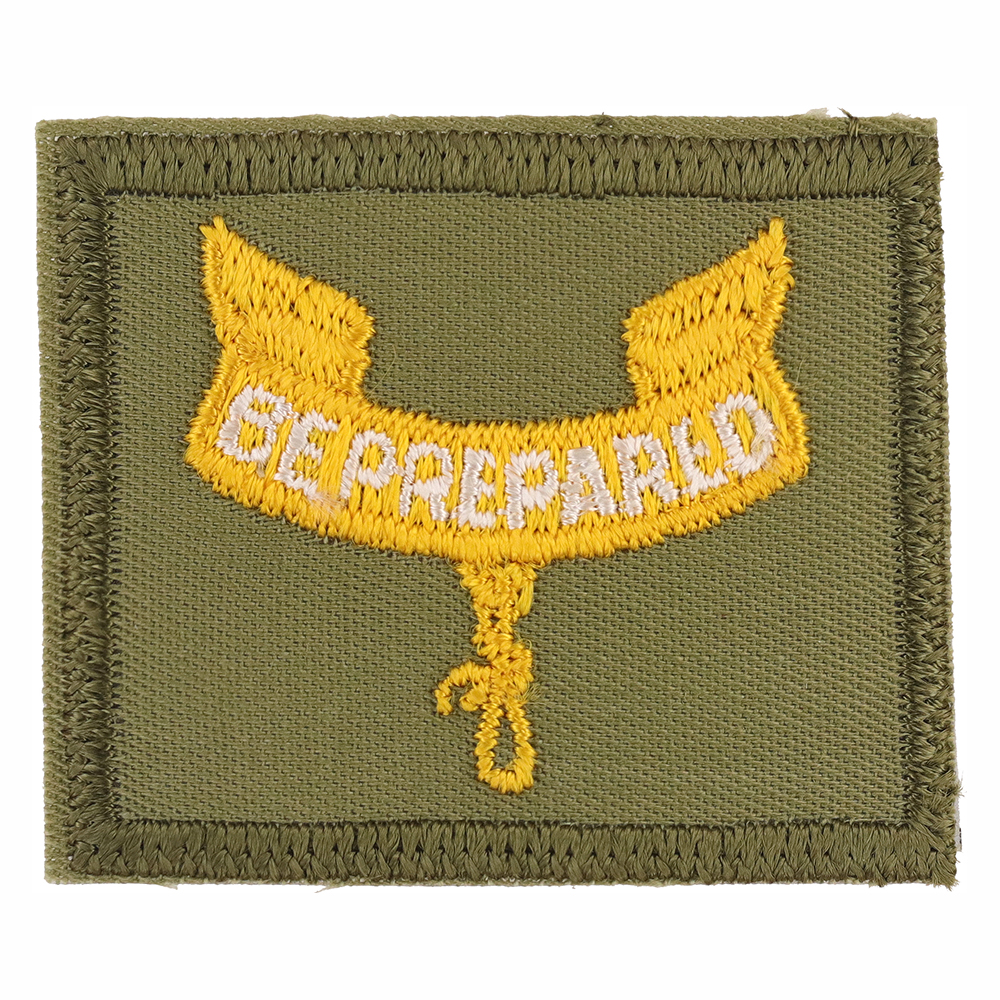
Fig. 1: SCB-1-7-02-Front
- Size: 34-15-8mm
- Cloth: Khaki fine right twill
- Border: Embroidered cut edge

Fig. 2: SCB-1-7-02-Magnified-Scroll-Left
- Scroll Right: Very shallow concave curve scroll top, bottom of scroll top joins smile at smile corner, closed ended smile, lower corner of scroll rounded
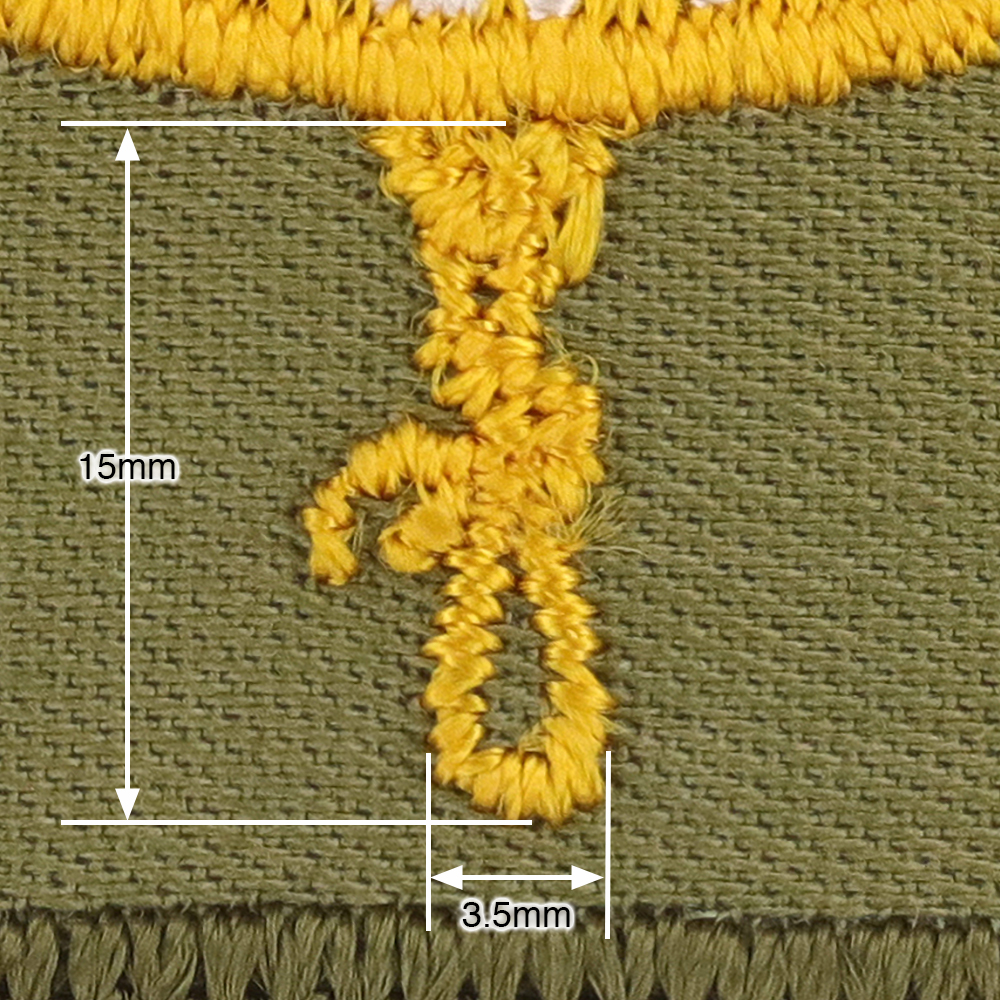
Fig. 3: SCB-1-7-02-Magnified-Knot
- Knot: 15mm x 3.5mm wide knot loop
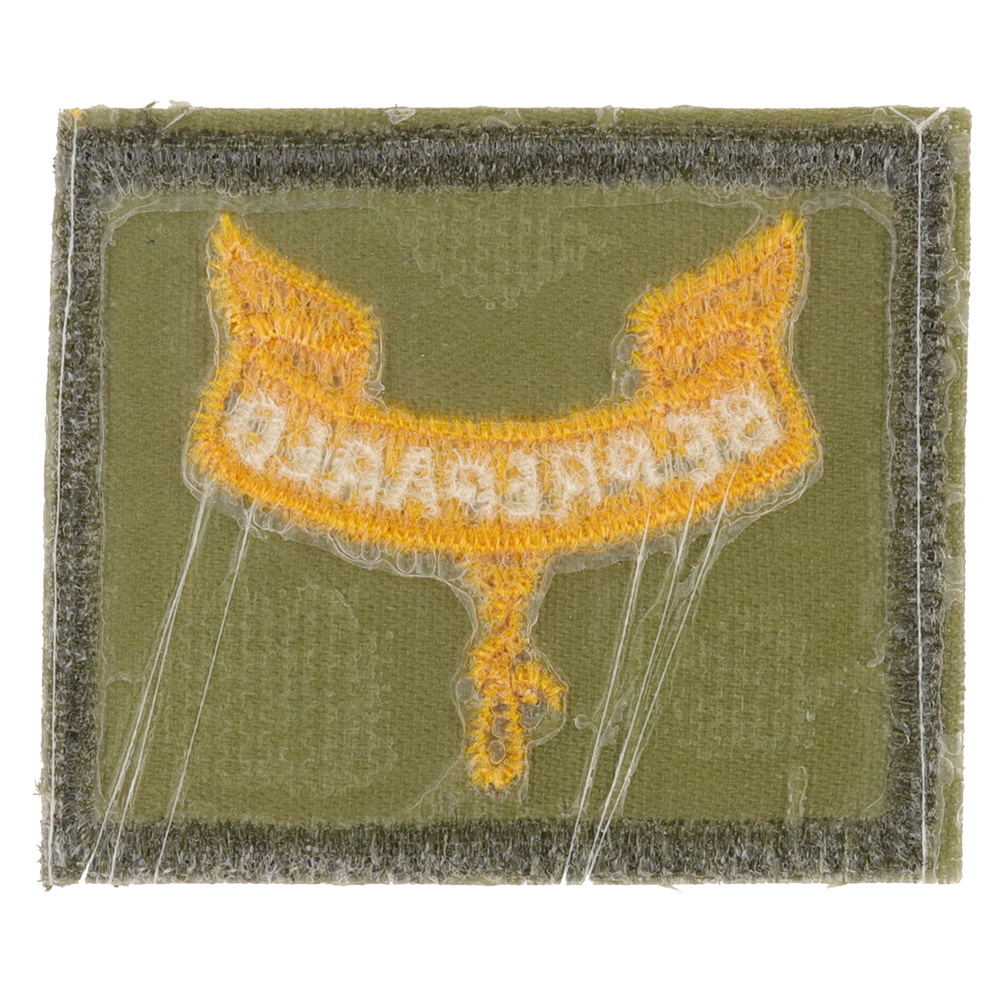
Fig. 4: SCB-1-7-02-Reverse
- Back: Clear waffle plastic back
Item Name: Second Class Badge 1972
Item ID: SCB-1-7-02
Collector Rating: 1
Requirements January 1967 until June 1972
To become a Second Class Scout, you must show by your attendance record that you have been active in troop and patrol meetings and activities for at least one month since becoming a Tenderfoot Scout. While a Tenderfoot Scout, do the following;
1. Tell what precautions must be taken for safe hiking.
2. a) Take three hikes, each on a different day, of not less than five miles each with your troop, your patrol, an adult, or another Scout who is at least Second Class. (b) Before each hike, submit a hike plan for approval (unless this is a troop hike) to your Scoutmaster or an adult assigned by him. (c) Before leaving on each of these hikes, present yourself (to your hike leader or companion) for inspection suitably clothed for the locality, season, and weather and equipped for the occasion. (d) On each of these hikes, observe proper hike precautions. (It is suggested that numbers 5, 7, and 10 be completed on these hikes)
3. Identify on a topographic map at least ten different map symbols including contour lines.
4. (a) Explain how a compass works. Give its eight principle points. (b) Set a compass and use it to read at least three bearings in degrees.
5. (a) Show how to orient a map. (b) Use a map (preferably a topographic map) and a compass to follow, far enough to prove your ability, a route indicated on the map.
6. (a) Explain how to keep from getting lost. (b) Explain what you would do if you did become lost.
7. (a) Identify local plants that may cause skin poisoning. (b) Find in the field ten different kinds of wildlife (mammals, birds, reptiles, amphibians, fish, insects) or evidence of them. Tell what they are, describe the natural surroundings where each was found, and explain how this wild life depends on plants.
8. Do two of the following;
Follow for a half mile a trail made with trail signs or by a person wearing tracking irons or dragging a whifflepoof.
Follow for a quarter mile the track of a person or animal in soft ground or snow, reading the main meaning of the track.
Follow another Scout who knows that you are stalking him for a distance of a half mile, without being seen by him.
9. Correctly sharpen a knife and ax and give rules for their safe use.
10. a) Use an axe correctly to prepare kindling or fuel wood. (b) Build a fire on a safe spot using not more than two matches. On this fire, (c) cook – without utensils – a meal from raw meat (or fish or poultry) and at least one raw vegetable. (d) Properly dispose of garbage, put out your fire, and clean up the cooking area.
11. (a) Tell how, in an emergency, you would reach a doctor or a hospital. (b) Explain what first aid is and tell how to act in case of an accident. (c) Show how to handle “hurry cases” of arterial bleeding and stopped breathing, and tell what to do for poisoning by mouth. (d) Demonstrate first aid for shock and fainting. (e) On yourself, show what to do for cuts and scratches, burns and scalds, blister on heel, bites or stings of insects and chiggers and ticks, skin poisoning from poison plants, sprained ankle, object in eye, nosebleed. (f) Show how to sterilize a dressing.
12. After completing the above test, meet with your Scoutmaster 9or an adult assigned by him) in a personal conference. At this meeting, complete to his satisfaction the following:
a. Discuss your idea about the meaning of the Scout Oath (or Promise), the Law, motto, and slogan; and give examples to show that you do your best to live up to these ideals in your daily activities.
b. Describe several Good Turns you have done and explain how you think they helped others.
c. Look over the tests for First Class and discuss how you intend to progress toward that rank.
Requirements June 1972 until December 1977
1. Be active in your troop and patrol for at least 3 months as a Tenderfoot Scout.
2. Show Scout spirit.
3. Earn three more skill awards.
E4. arn two more merit badges.
5. Take part in a personal growth agreement conference.